

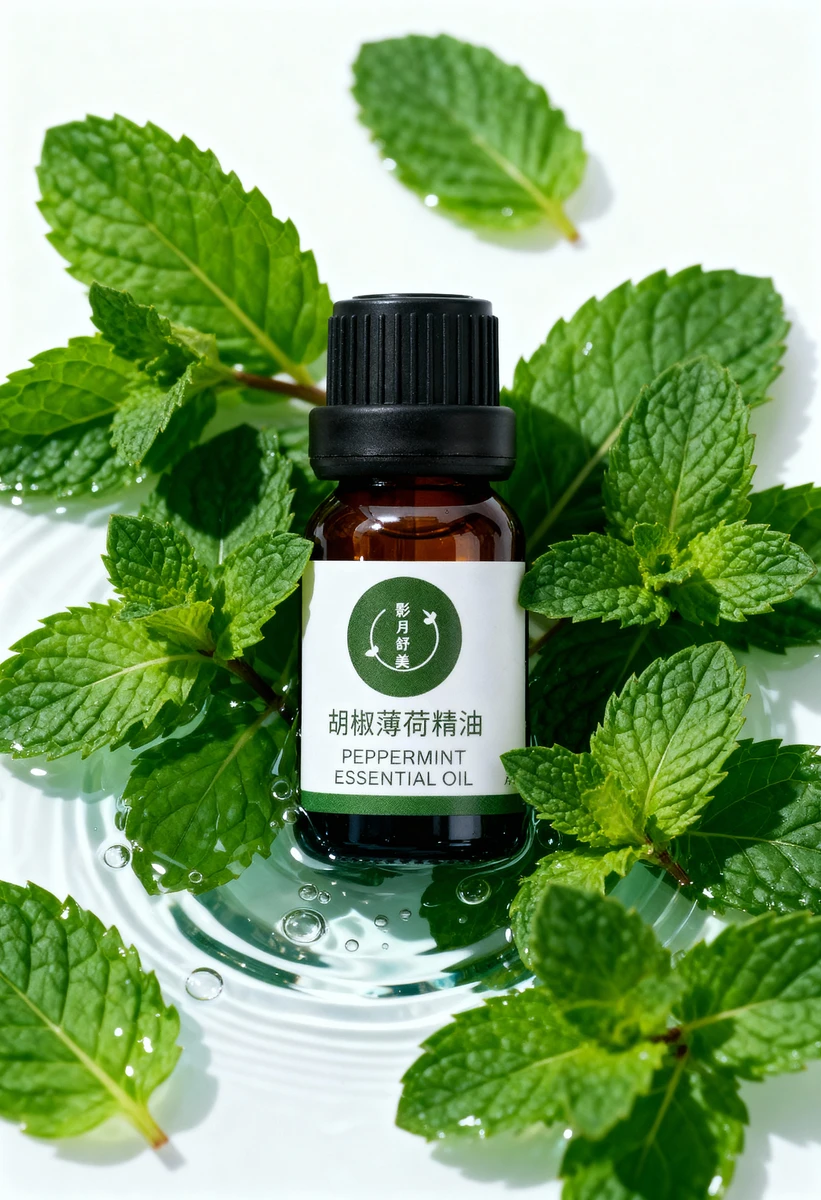
Peppermint Essential Oil
$51.00
The Health Wisdom of Peppermint Essential Oil in Traditional Chinese Medicine: Cooling and Relieving Stagnation, Opening the Orifices, Revitalizing the spleen and stimulating appetite
“Refreshing oil”
Enters the Lung, the Liver and the Spleen (Stomach) Meridian
Common Benefits: dispelling wind-heat, clearing the head and eyes, soothing the liver to relieve stagnation, opening the orifices to alleviate pain, and awakening the spleen and promoting appetite.
Introduction
In the world of aromatherapy, peppermint essential oil is highly favored for its intense cooling sensation and invigorating effects. From the perspective of Traditional Chinese Medicine (TCM) theory, this essential oil is not merely a simple volatile oil but rather a “wind medicine” with distinct properties. Its pungent, cooling, and penetrating nature deeply aligns with TCM’s health philosophy of regulating Qi, balancing Yin and Yang, and promoting overall well-being.
I. TCM Properties: Pungent and Cooling to Release the Exterior, Soothing the Liver and Clearing the Head and Eyes, Regulating the middle jiao and fortifying the Spleen
Peppermint essential oil has a pungent and penetrating aroma, a cool nature, and a pungent, slightly bitter taste. Its characteristics highly correspond to TCM’s description of mint.
• Pungent Nature: Can disperse and move, helping to expel external pathogens, promote Qi flow, relieve stagnation, and clear rashes and toxins.
• Cool Nature: Can clear heat and purge fire, eliminating heat pathogens. It is effective for wind-heat symptoms or internal stagnant heat.
Meridian Affinity: Primarily enters the Lung Meridian and Liver Meridian, but also the Spleen and Stomach Meridian.
• Lung Meridian: Can diffuse Lung Qi, disperse wind-heat, soothe the throat, and promote rash eruption. It alleviates symptoms such as headaches, sore throat, and nasal congestion caused by wind-heat common cold.
• Liver Meridian: Can soothe Liver Qi, clear the head and eyes, and relieve irritability, headaches, dizziness, and red, swollen eyes caused by Liver Qi stagnation or Liver fire flaring up.
• Spleen/Stomach Meridian: While traditionally categorized in TCM as entering the Lung and Liver meridians, modern pharmacology and aromatherapy practice have demonstrated Peppermint’s ability to regulate the stomach, relieve distension, ease spasms, invigorate the spleen to stimulate appetite, and arrest vomiting and nausea. Thus, its affinity also extends to the Stomach meridian.
Its core efficacy includes: dispelling wind-heat, clearing the head and eyes, soothing the Liver to relieve stagnation, opening the orifices to alleviate pain, and regulating the middle jiao and fortifying the Spleen.
II. Health Preservation Applications: The Principle of "Unblocking"
TCM believes that “pain arises from obstruction.” Many discomforts stem from stagnation of Qi and blood. The pungent and dispersing nature of peppermint essential oil is particularly effective in clearing various types of stagnation.
1. Clearing Heat and Releasing the Exterior, Resisting Warm Pathogens (Acts on the Lung Meridian)
• Application: During the transition between spring and summer or at the initial signs of wind-heat common cold, such as mild fever, headache, or nasal congestion, mix 3-5 drops of peppermint essential oil with a carrier oil and apply to Fengchi (GB20)穴, temples, and the back of the neck. Alternatively, use it in a diffuser.
• TCM Interpretation: Its pungent and cooling properties can substitute for “mint” in herbal medicine, quickly opening the pores and expelling wind-heat pathogens from the surface. This prevents pathogens from penetrating deeper, embodying the TCM principles of “preventing disease” and “releasing the exterior through sweating.”
2. Soothing the Liver to Relieve Stagnation, Regulating Emotions (Acts on the Liver Meridian)
• Application: When feeling down, stressed, or irritable, place one drop of peppermint essential oil on your fingertips and inhale gently, or apply it to your temples and behind your ears.
• TCM Interpretation: The Liver governs dispersion and regulates Qi flow and emotions. Stagnant Liver Qi can lead to depression and fire. The fresh, pungent, and dispersing nature of peppermint essential oil can quickly relieve stagnant Liver Qi and clear Liver fire, thereby easing tension, uplifting the spirit, and promoting mental clarity.
3. Opening the Orifices to Relieve Pain, Clearing the Head and Eyes (Acts on the Liver and Lung Meridians)
• Application: For headaches, dizziness, or eye strain caused by staying up late, mental exhaustion, or external pathogens, highly dilute one drop of peppermint essential oil and gently massage it into the temples and forehead (avoiding the eyes).
• TCM Interpretation: “All wind-type dizziness belongs to the Liver.” Discomfort in the head and face is often related to wind pathogens disturbing the upper body, Liver fire flaring up, or Qi stagnation. The pungent, cooling, and penetrating properties of the essential oil can guide its effects upward to the head and eyes, disperse wind-heat, calm Liver Yang, and quickly open the orifices to relieve pain and dizziness.
4. Harmonizing the Middle Burner and Aiding Digestion, Relief Gastrointestinal Discomfort
• Application: For food stagnation, bloating, or nausea, mix 1-2 drops of peppermint essential oil with a carrier oil and massage the abdomen clockwise.
• TCM Interpretation: Its pungent and aromatic Qi-moving ability can awaken the spleen and harmonize the middle burner, promoting the movement of Qi in the spleen and stomach and relieving abdominal distension caused by Qi stagnation or food accumulation. Its cool nature can also mildly clear stomach heat.
III. Contraindications and Precautions: Use Based on Pattern Differentiation
Peppermint essential oil is potent but has strong characteristics. It must be used cautiously and in accordance with TCM pattern differentiation.
• Constitution Differentiation: Its pungent, cooling, and dispersing nature means that individuals with “deficient-cold constitutions” (e.g., fear of cold, pale complexion, susceptibility to diarrhea) or Qi deficiency with spontaneous sweating should use it sparingly or avoid it to prevent further depletion of Yang Qi and Qi-Yin.
• Avoid Use During Pregnancy and for Infants: Pregnant and breastfeeding women and infants have sensitive nervous systems and should avoid peppermint essential oil, as its strong stimulating properties may cause discomfort.
• Stop Once Symptoms Improve: As a representative exterior-releasing medicine, its effects are rapid but not suitable for long-term use. Discontinue use once symptoms improve.
IV. Conclusion
Peppermint essential oil, like a refreshing and awakening breeze, finds its application beyond simple relaxation under the guidance of TCM theory. It becomes a valuable companion for regulating Qi and relieving stagnation. By wisely utilizing its “pungent, cooling, and dispersing” properties, we can address wind-heat external pathogens, emotional stress, and head discomforts in modern life. However, remember its “potent” nature and use it based on pattern differentiation to safely harness this natural power, unblock the orifices, relieve stagnation, and protect the clarity and balance of the body and mind.